
















When Does Gamification Work — and When Is It Just Decoration?

Add a leaderboard. Set up a points system. Hand out badges. Then wait — does engagement go up? Usually not.
Gamification isn't a guaranteed way to capture attention. It's a tool that works when the right questions get the right answers first. Applied in the wrong place, it's just another piece of interface decoration.
Badges alone don't motivate
A badge rewards a behaviour. If the behaviour hasn't changed, the badge is just an icon. It flashes on screen, then gets forgotten.
The common mistake: teams pick the mechanic first and think about the purpose afterwards. The decision to 'gamify it' comes before anyone asks which behaviour is worth rewarding. That order needs reversing.
A basic finding from behavioural science holds here: extrinsic rewards reinforce a behaviour that already exists. Creating a behaviour that doesn't exist yet, purely through rewards, is far harder. A badge doesn't generate motivation — it makes existing motivation visible.
There's also a novelty effect at play. Engagement rises in week one, as everyone chases the new badges. By month two the curve drops, because the system hasn't changed but the underlying behaviour hasn't either. The question to ask is simple: which behaviour, repeated how often, for what outcome? No answer, no gamification — just decoration.
When gamification actually works
Gamification earns its keep when three conditions line up.
- Repeated behaviour: When learning isn't a one-off but a habit — daily product knowledge checks, weekly sales practice — visible progress keeps people coming back.
- Team competition: Leaderboards mean something when the goal is collective, not individual. Branch against branch, team against team builds real belonging.
- Visible progress: Across a longer development path — a 90-day onboarding, a certification programme — a roadmap shows learners exactly where they stand.
In these scenarios, a badge isn't a prize. It's a signal: here's where you are, here's where you're headed. The motivation comes from that visibility, not the badge itself.
A concrete example
Picture a sales team. Every week they need to learn a product update and explain it correctly to customers. That's a repeated behaviour. Comparing teams makes sense, because the goal is shared: stronger selling. Progress runs over a long stretch, since the learning continues week after week. All three conditions apply — this is where gamification genuinely works.
When it's just decoration
Gamification does almost nothing for one-off mandatory training.
Take an annual information security course, or a compliance module everyone has to complete regardless of interest. A badge doesn't change the obligation — it just adds an icon to the screen.
Bolting a badge onto mandatory training is like hanging a flower on a locked door. The door is still locked.
One-off content has no repetition, no competition, no long-term progress. None of the three conditions apply. Gamification can't be more than decoration here — sometimes it's simply a distraction.
There's a bigger cost too: gamification used where it doesn't fit erodes trust in it where it does. Learners start seeing every badge the same way — an icon that means nothing. Scattering gamification everywhere can do more damage than using it nowhere at all.
A quick check
- Will the behaviour repeat? If not, review the content before you gamify it.
- Does comparison make sense? On individual mandatory tasks, a leaderboard creates pressure, not motivation.
- Is the journey long enough? A single-session course gains nothing from a roadmap.
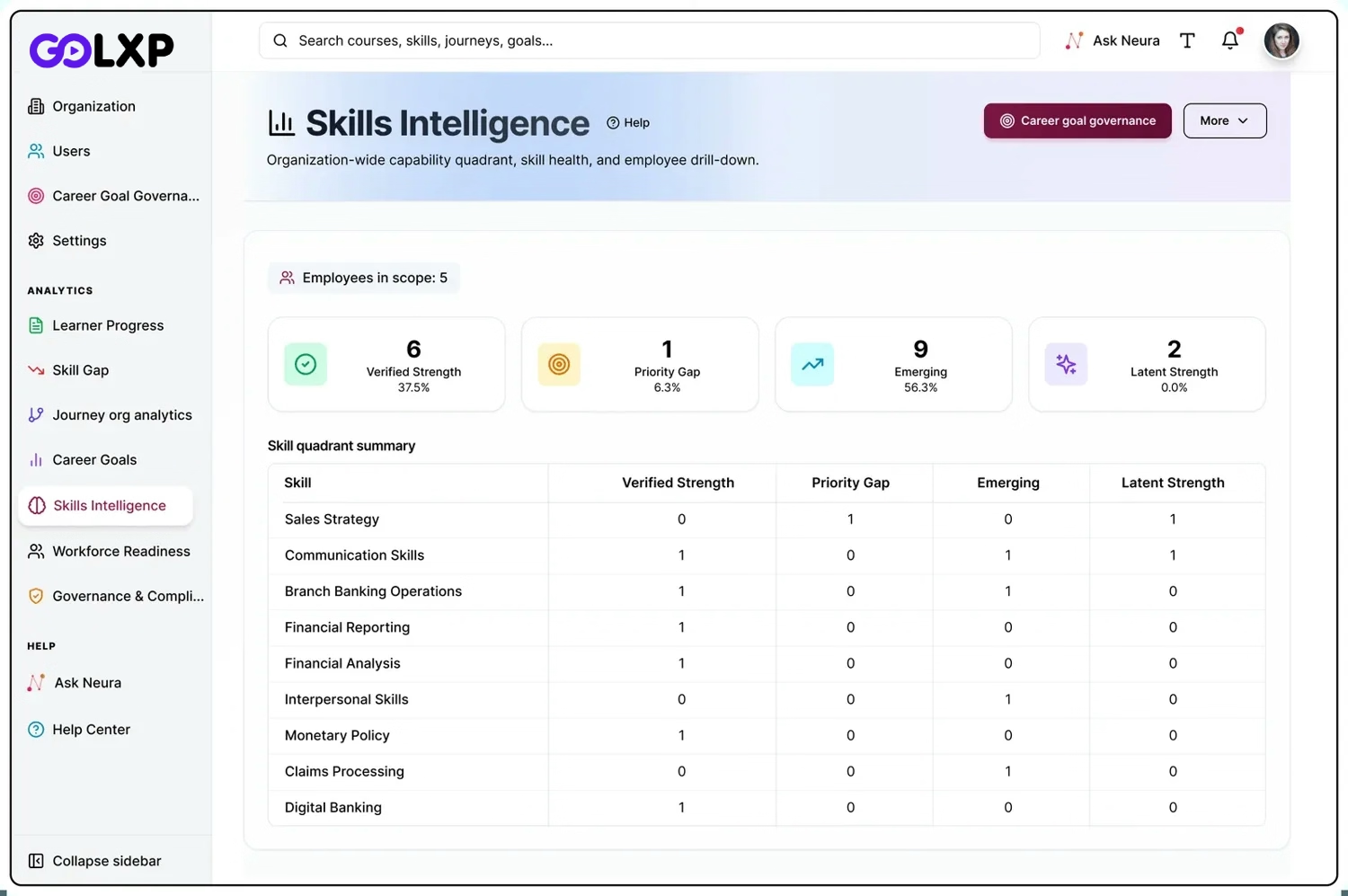
Gamification, built into GOLXP
GOLXP treats gamification as part of the learning journey, not something bolted on afterwards. The mechanic only switches on once the behaviour it rewards has been defined.
- Progress bars: Learners see themselves completing a roadmap, not just a module. Progress updates with every session, with each completed step clearly marked.
- Behaviour-linked badges: A badge is earned only when a defined behaviour is repeated — not for watching a single video. The criteria are set by the L&D team.
- Team leaderboards: Group-based comparison, rather than individual ranking, keeps competition aligned with the learning goal.
- Milestones: Longer programmes flag key stages along the way, so learners always know how far they've come.
The result: L&D teams know exactly which behaviour they're rewarding. They can see which badge maps to which behaviour, and adjust the mechanic when it needs adjusting. Gamification stops being a decorative option and becomes a strategic decision.
Before adding a badge, there's only one question worth asking: is this a behaviour we actually want repeated? If yes, gamification works. If no, it's decoration.