
















The Right Time to Move Content Production In-House
Need an induction course for new starters? A ready-made catalogue gets it live within days. Need training that explains your product roadmap, your internal approval process, or your brand voice? That's exactly where the catalogue runs out of road. Knowing when to bring content production in-house comes down to balancing speed against specificity. This piece sets out a practical framework for making that call.
The limits of buying
Ready-made libraries like GOCATALOG are built for speed. They offer professionally produced modules on leadership, communication and core skills that can go live within hours. For a learning team, that means skipping weeks of scripting, filming and design work. It's the right starting point for teams that need broad coverage on a modest budget.
But off-the-shelf content is, by definition, generic. It cannot explain your CRM workflow, the features of your new product, your internal sign-off process, or the way your brand actually speaks. That knowledge sits nowhere but inside your organisation. No amount of catalogue spend closes that gap, because it isn't a product you can purchase — it's institutional knowledge only you hold.
Signs it's time to build
Not every recurring need justifies in-house production. But when the following signs stack up together, outsourcing turns slow and expensive.
- Update frequency: If the same topic needs revising more than once a year, the brief-revise-approve cycle of an external supplier will outpace your actual production timeline.
- Product or process dependency: When content is tied directly to your product's interface, release notes or internal procedures, an outside team has to rebuild context from scratch every single time.
- Brand and compliance sensitivity: Content that carries legal, financial or brand risk moves through approval faster — and more safely — when it stays in-house.
- Volume threshold: Once you're producing dozens of modules a year, the per-unit cost of in-house production drops well below what an external supplier can offer.
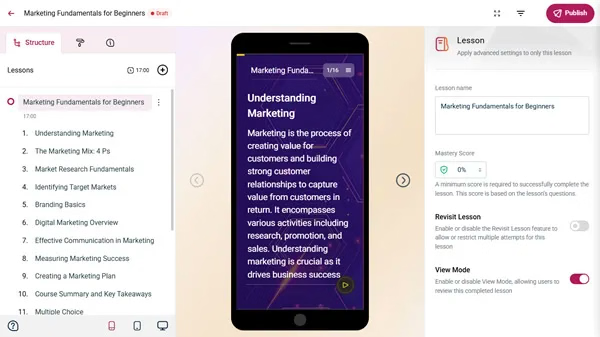
This is where GOTOOLS comes in. Authoring tools like Craft let a product specialist or an HR manager who isn't an instructional designer build a quality, interactive module on their own. Production moves to whoever actually knows the subject best — not to whoever was hired to describe it.
When outsourcing still wins
In-house production isn't the right answer for everything. Two situations still favour buying it in.
- General skills topics: For leadership, time management or communication — subjects every organisation needs but none owns — GOCATALOG's ready library is both cheaper and faster. There's no point reinventing what already exists.
- Large, one-off projects: A corporate film, a simulation, or a high-production training series can outstrip an in-house team's capacity. GOFACTORY's specialist production expertise is the lower-risk choice here. Building a permanent production capability for a single, one-time need rarely pays for itself.
The right question isn't 'build or buy' — it's how often this content will change, and how specific it is to your organisation. Once those two answers are clear, so is the decision.
Building the hybrid model
For most organisations, the right answer isn't one model — it's all three working together.
Bringing content production in-house isn't a technology decision. It's a capacity decision.
In practice, that looks like this: general development topics come from GOCATALOG, organisation-specific content that changes often is built in-house with GOTOOLS, and large one-off productions go to GOFACTORY. All three come together as a single, consistent learning experience inside GOLMS or GOLXP — the learner never sees where any given module came from.
Start small. One team, one topic, one pilot module built with GOTOOLS is enough to begin. Review the results after three months: has production time dropped, and did quality hold up? If the answer is clear, expand the scope. If not, find where the process stalled and fix it. In-house production isn't a project you finish — it's a capability that matures over time.