
















Microlearning: Is Short Content Always Good Content?

Microlearning has become one of the most overused words in corporate L&D. Popularity, though, is not the same as correct practice. Most teams assume microlearning means chopping a long course into smaller pieces. Real microlearning is a separate design discipline, with its own rules.
The “short equals effective” myth
Producing short content looks like an easy target: cut the runtime, protect attention, push completion rates up. But duration alone guarantees nothing. Splitting a 45-minute course into nine five-minute clips doesn’t make it microlearning — it just makes it smaller. The content still carries the same density of information, only now it’s interrupted more often. For the learner, the result is usually worse: context has to be rebuilt every time, the thread between pieces disappears, and a false sense of “done” stands in for any real change in behaviour.
The cost of this mistake is easy to miss. Completion rates go up, satisfaction surveys look fine, but on-the-job performance doesn’t move. That’s because what’s being measured is consumption, not learning. Any programme that treats microlearning as a format choice rather than a design decision carries this risk.
Microlearning isn’t a question of length. It’s a question of purpose.
Take a sales team learning to handle objections. A three-minute module built around one objection works, because it has one clear target. Apply that same three-minute template to five unrelated topics — pricing policy, competitor positioning, brand messaging — back to back, and learners are left with fragments, not knowledge.
Microlearning is a design discipline
Real microlearning doesn’t start by trimming a long asset — it starts from scratch, built around a single objective. Each module targets one skill or one behaviour. It stands on its own; it shouldn’t depend on the module before or after it. What’s learned should be applicable straight away, so the gap between theory and practice stays short. And the module is built to be revisited, not consumed once and forgotten.
- Single objective: each module targets one decision or one action, not a whole topic.
- Stands alone: a learner can make sense of it without the module before or after.
- Immediate application: learners can go back to their work and apply it straight away.
- Built for reuse: modules are designed to be revisited on demand, not consumed once.
These four traits work together. Drop one and a module stops being microlearning — it’s just short content. A single-objective module that isn’t self-contained, for instance, sends the learner hunting for the missing piece, and the whole experience falls apart.
Micro or long-form?
Micro-format earns its place in two situations. First, when what’s being taught is one clear skill or behaviour — filling in a form correctly, operating equipment safely, handling a single type of objection. Second, when information needs to be recalled and refreshed often — compliance rules, product updates, sales talking points that change regularly.
Some subjects, though, can’t be compressed. A complex process, a multi-step workflow with interdependent decisions, or anything that requires a shift in attitude or behaviour — leadership, negotiation, culture — needs depth and context. Splitting these into micro pieces loses the whole for the sake of the parts.
- Micro works for: single skills and step-by-step reminders.
- Micro works for: information that changes often and needs frequent recall — compliance, pricing, product.
- Long-form is needed for: multi-step processes with interdependent decisions.
- Long-form is needed for: topics that require attitude or behaviour change, such as leadership or negotiation.
On a production line, a new safety step can be reinforced with a two-minute reminder module. But that same shift supervisor’s ability to make decisions under pressure needs a longer, scenario-based course with role-play and feedback built in. Forcing both into the same mould weakens each of them.
Modular production with GOFACTORY and GOTOOLS
Getting this distinction right has to happen at the start of production, not after. At Respongo, the GOFACTORY team maps content needs module by module: deciding upfront which subject suits a single long-form narrative and which is better built as a reusable micro module. GOTOOLS then lets authoring teams build those modules quickly and consistently, so every module carries the same structure and the same quality.
- Needs analysis: GOFACTORY decides which topics need micro treatment and which need long-form, at the start of the content strategy.
- Modular production: GOTOOLS gives authors standard templates for building consistent modules at speed.
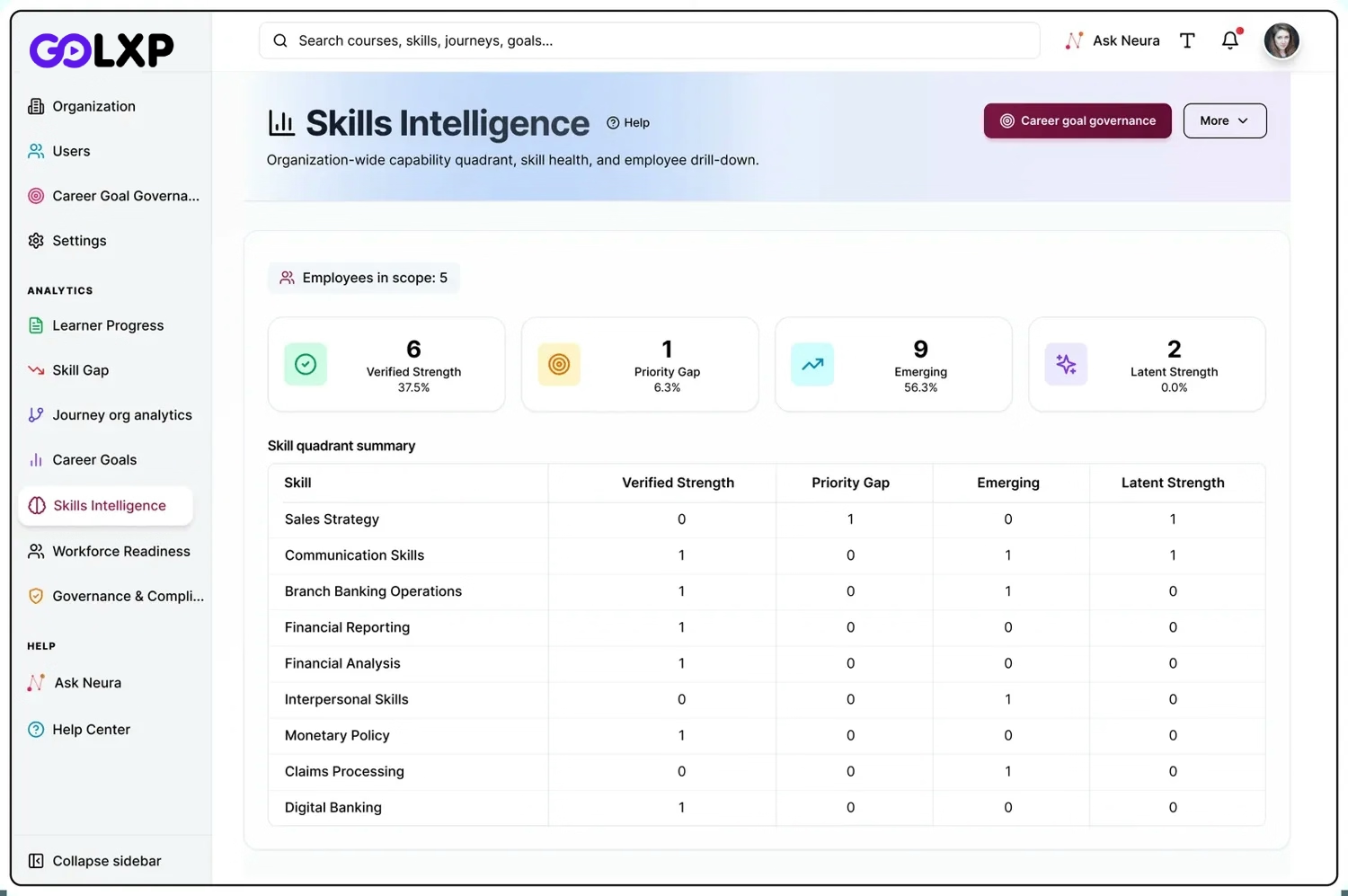
- Right-time delivery: GOLXP surfaces the right module to the right learner at the moment they need it.
- Easier upkeep: a modular structure means updating one module doesn’t mean rebuilding the whole course.
Before anything goes live, each module is checked against its target behaviour, not its runtime. What matters isn’t how short a module is, but whether learners can do the right thing once they’ve finished it.
Microlearning isn’t about making content shorter. It’s about designing it correctly. Producing short content is easy; producing content with the right objective, at the right moment, with the right independence, takes discipline. Respongo’s modular production approach makes that discipline repeatable across every project.