
















How to Maintain Training Standards Across Your Channel

As your channel grows, control slips. Every distributor, every franchise site, every reseller tells your product story their own way. The drift shows up in your brand first, and in your sales figures soon after. No matter how good the material coming out of head office is, the story told on the ground keeps moving further from what head office meant.
This piece covers how to hold a training standard across a multi-site channel: one source of content, room to localise it, and completion visibility across the whole network. The industry has a name for this — extended enterprise learning, taking training beyond your own walls to the partners who sell and support your product.
The cost of fragmented training
Without a centralised training programme, every site improvises. A sales rep mispositions the product. A technician learns half a procedure. One site sells the product correctly; another is still pitching a feature that was discontinued two updates ago.
The problem grows quietly. Head office produces solid training material, but by the time it reaches the field, it has been trimmed, reinterpreted, or simply set aside. Nobody at head office actually knows what's left of the original message, because there's no mechanism to check. It isn't only a messaging problem, either — a regulatory change or a safety procedure that reaches the field late puts both the brand and the partner at risk.
- Brand messaging dilutes: each site tells the story in its own words, and the corporate tone disappears.
- Product knowledge goes stale: updates happen centrally but never reach the field.
- Performance gaps widen: well-trained partners outsell the rest, and the gap compounds.
- Compliance risk builds up: regulatory and procedural updates don't reach the field on time.
One source, centrally managed
The fix isn't training every site separately. It's producing one accurate source of content and distributing it to the whole channel at once. That's not head office micromanaging the field — it's head office guaranteeing the field is drawing from the right source.
Content built with GOFACTORY is written in your brand voice, with the product story told correctly from day one. Produce it once, distribute it everywhere. When there's a launch, a price change, or an updated sales argument, the only thing that needs to happen is updating the central content — the platform handles the rest. Reaching fifteen partners takes the same process as reaching a hundred and fifty, because distribution is tied to the source, not to each site.
- One build, many destinations: content is produced once and reaches the entire network simultaneously.
- Updates propagate instantly: change the product, update the content centrally, and the field is current straight away.
- Corporate tone holds: every partner delivers the same message, in the same words.
- Scaling stays cheap: a bigger network doesn't mean proportionally more content work.
Local flexibility, brand consistency
Centralised doesn't mean identical. A distributor in one region may operate in a different language, under different market conditions. A well-designed programme allows for that — otherwise the field doesn't adopt it, it just ignores it.
The core stays fixed: product facts, brand voice, and compliance requirements don't change. What flexes is local examples, language, and delivery format. Over-standardising carries its own risk — content that never touches a partner's reality gets set aside just as fast as content that's out of date.
A well-run extended enterprise programme balances central control with local flexibility — neither one cancels out the other.
- Language and localisation: content can be delivered in different languages without touching the core message.
- Regional examples: local case studies and scenarios can be layered on top of the standard material.
- Flexible delivery: some sites prefer classroom sessions, others go fully digital — the platform supports both.
- Segmented pathways: a new partner and a seasoned one can follow different routes through the same core content.
Visibility across the channel
Extended enterprise learning means opening training beyond your own employees to distributors, franchisees, and partners. Extending reach shouldn't mean losing sight of it — managing training for people who aren't your employees calls for a different ownership model, with access and reporting thought through separately.
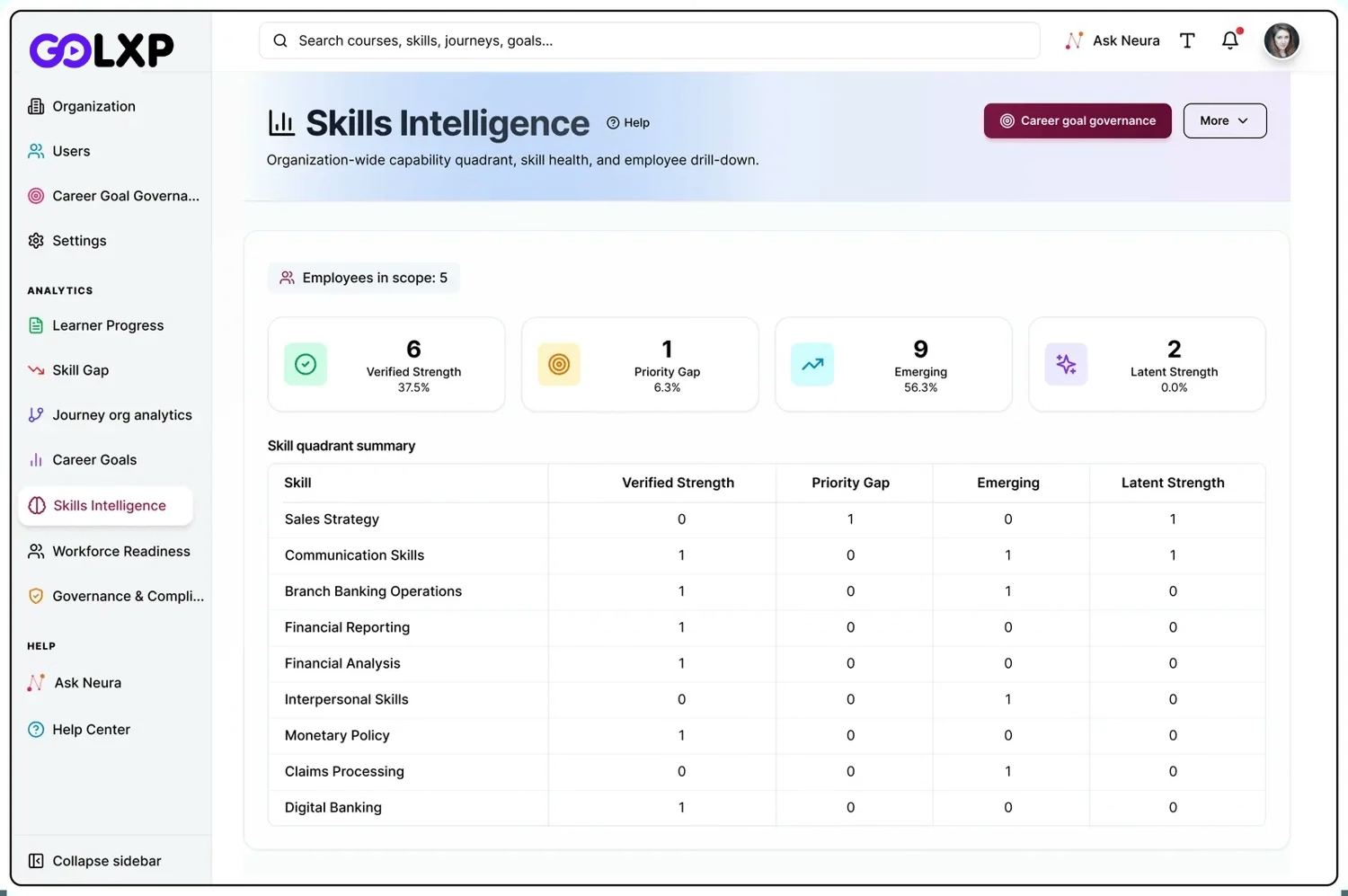
With GOLMS, every site's training status is visible from a single screen. Who has completed the programme, who is falling behind, which region carries risk — all of it, in one place. A regional manager sees their own partners; head office sees the whole network. On the GOLXP side, each partner profile can follow its own path: a newly onboarded partner starts with the fundamentals, an established one is routed straight to advanced content.
- Completion tracking: progress is visible by partner and by individual learner, from one dashboard.
- Risk surfaces early: sites that haven't completed training are flagged automatically.
- Reporting stays centralised: comparing performance across the channel takes one click, not a week of chasing spreadsheets.
- Permissions stay clear: each regional manager sees only their own network; head office sees the full picture.
As your channel grows, your training programme needs to scale with it. Centralised content, local flexibility, and channel-wide visibility, working together, mean every site represents the same brand with the same accuracy. Built as one system rather than three separate fixes, this is what makes the difference stick.